Australia's international education sector is navigating a defining moment. We have a reputation as a premium study destination that operates with one of the most comprehensive regulatory environments for international education globally. And yet, Australia faces ongoing challenges around quality and integrity. Concentrated in a small proportion of agents and providers, these integrity concerns threaten not only Australia's hard-won reputation, but the lives of the very international students we are here to serve.
There are shortcomings in our regulatory system that are being exploited. New Agent Quality Research from the International Education Association of Australia (IEAA) sets out to address a long-standing gap; the fact that agent quality has not been a central feature of our system. The report does not propose an overhaul of existing regulation in Australia, but rather recommends building in layers of smarter, more transparent accountability and rewarding high quality partners.
The problem with the status quo
The research, published in March 2026 and undertaken by Edified, is candid about the shortcomings of Australia’s current system. Australia’s ESOS Act and the National Code of Practice place clear obligations on education providers to manage their agent relationships responsibly. However, education agents themselves remain largely outside the formal regulatory perimeter. When problems arise, responses are typically reactive, localised and entirely behind closed doors; a quiet contract termination takes place, leaving no sector-wide trace, and thereby allowing a problematic agent to simply move on to a new provider relationship.
Stakeholders who were interviewed for this research widely agree that Australia already has strong existing regulations for international education but that inconsistent and weak enforcement has been the core issue. They highlighted gaps with providers such as limited on-site inspections and over-reliance on ‘paper-based’ compliance, allowing poor practices by some providers to continue undetected which in turn enables bad actors to continue to operate. The clear consensus is that more rigorous, consistent enforcement — particularly through stronger monitoring and verification — would significantly improve student outcomes, agent behaviour and system integrity, without needing additional regulatory layers.
The report reviews international frameworks to assess global best practice, including the UK Agent Quality Framework, the US-based AIRC model, New Zealand's Code of Practice and EduCanada’s approach. The UK's framework scored strongly, valued for its student-centred design, practical provider-focused toolkits and a government-backed requirement for institutions which use agents to sign up to a national pledge. Whilst it provides lessons for Australia, even this model has weaknesses; there is no overarching agency accreditation, participation remains variable and data clarity is still maturing.
Across all international models reviewed, a persistent gap was identified: no framework systematically collects and publishes student feedback on agent performance. Quality is assessed through process compliance, training completion, or provider oversight, but not through verified student experience. This is a significant blind spot that any future Australian framework should address.
Three proposed models
The report proposes three policy models, each building in increasing levels of ambition, effort and complexity. They are designed as additive overlays to, and not replacements of, Australia’s existing ESOS architecture and are intended to be adopted progressively or in accordance with sector readiness.
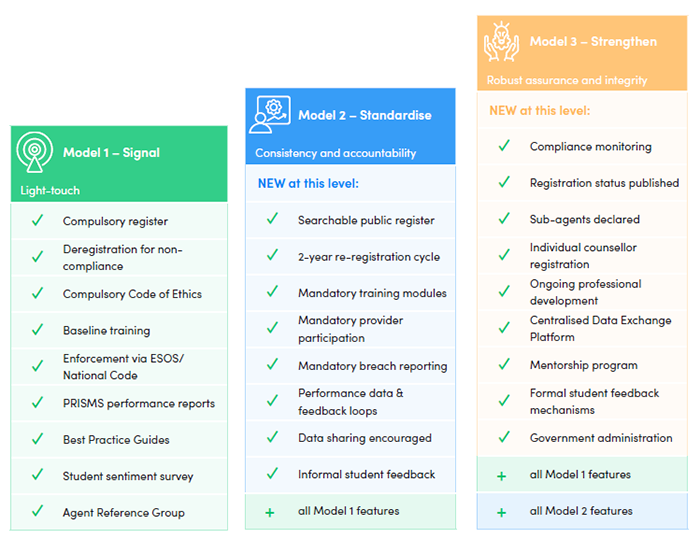
Source: Edified, Agent Quality Research, IEAA, 2026, p. 8
The first model, ‘Signal’, is a streamlined approach with a new education agent register as the centrepiece. Every agency working with an Australian provider would be required to register as well as to nominate an accountable person – not unlike the way CRICOS registration requires a Principal Executive Officer. Registered agencies would also need to agree to a Code of Ethics and complete baseline training.
The register, most likely built off the back of PRISMS, would significantly improve the government’s reporting capabilities of all education agents serving destination Australia. This in turn would give providers greater visibility of agent performance, as well as clear status categories, such as ‘provisional’, ‘registered’, ‘suspended’ and ‘removed’.
The second model, ‘Standardise’, builds consistency across the system. The register, detailed above, becomes searchable and publicly available. Re-registration is required every two years and training becomes mandatory for all accountable persons, with additional modules covering student safeguarding, mental health awareness, financial vulnerability and Australian workplace standards. Providers are required to work only with registered agents and to report terminations.
A structured quality assurance pathway, such as ‘warning’, ‘remediation’, ‘suspension’, ‘deregistration’, provides proportionate escalation for serious or repeated non-compliance. In addition, informal student feedback mechanisms are introduced and performance data begins flowing more systematically through PRISMS-linked reporting.
The third model, ‘Strengthen’, is the most comprehensive option. Individual counsellors are listed on the register alongside their agencies. Sub-agents must be declared, with master agents held fully accountability for their conduct. Registration requires demonstrated ethical practice and student-centred outcomes.
A centralised data exchange platform integrates PRISMS, TEQSA, ASQA, and Department of Home Affairs data. Genuine deterrence is provided through formal compliance monitoring, risk-based audits and tiered sanctions, including public visibility of registration status. A sector-led awards program and mentorship scheme reward excellence. Importantly, formal, multi-touchpoint student feedback is collected at pre-departure, post-arrival and post-semester stages, with results feeding into agent performance scorecards.
IEAA’s Agent Quality Research project provides government and other international education stakeholders with evidence-based, sector-informed perspectives and supports a co-designed approach to future frameworks. Indeed, the research itself demonstrates the willingness and capacity of our sector to collaborate and co-create solutions. Its menu of measured and meaningful regulatory models can inform the next phase of international education policy development.