This article is adapted from a ‘Provocations’ address that Keri provided at IEAA’s National Symposium on 13 February 2026.
Partnerships have long been at the core of international education in Australia. They are one of the reasons the sector has thrived for so many years. Some key examples of partnerships are:
- Agent collaborations: 87% of international students coming to Australia are the result of strong partnerships with education agents.
- Articulation agreements: Education providers have spent years developing articulation agreements that provide diverse pathways for international students seeking to study in Australia.
- Student mobility: Australian universities maintain over 4,400 exchange programs for outbound mobility and that figure reaches nearly 9,000 when international research collaboration agreements are also taken into account.
Partnership across sectors
These examples demonstrate that collaboration is deeply embedded in our sector. However, there is one particular type of partnership that has changed quite significantly in recent years; it is this shift that deserves closer attention. I am referring to partnerships across subsectors within international education — the relationships that allow international students to move from English language programs to higher education or VET programs, or from the school sector into other parts of the education system. These partnerships have been one of the great strengths of Australia’s international education model creating a rich and diverse environment.
A recent shift
Using data from Australia’s Department of Education, we can see clearly how international student movement across sectors has evolved over time. In higher education in 2019, before COVID, the distribution of commencing students reveals a balanced and interconnected system. At that time, 55% of international students began their higher education program directly and 45% came via another sector. The majority of those international students — 22% of all commencing higher education students — came through English language programs before transferring into higher education. In other words, the system was almost evenly split between direct entry and pathways from other sectors.
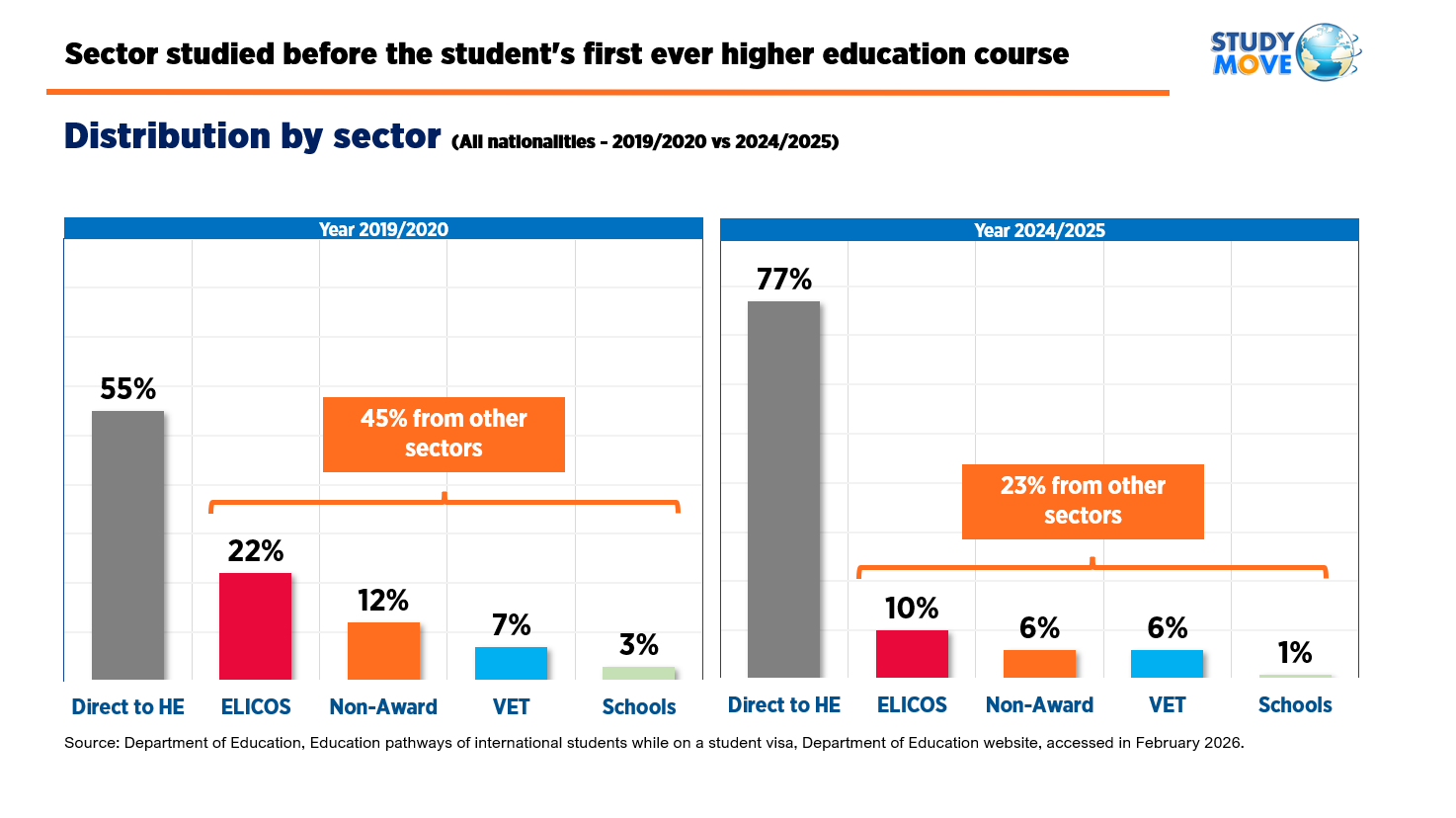
In contrast, the most recent available data shows that close to 80% of international students now enter higher education directly. The proportion transferring from other sectors has effectively been cut in half.
Why?
Data suggests that this shift is closely related to enrolments in ELICOS programs. In short, when ELICOS enrolments decrease less students transfer to other sectors such as higher education. This forces providers to rely more on offshore recruitment.
Before COVID, the sector reported 140,000 enrolments in ELICOS. International border closures in 2020 and 2021 led to a massive contraction in onshore international student numbers, particularly within ELICOS. Higher education providers found themselves unable to rely on onshore recruitment, requiring them to strengthen offshore recruitment strategies. This marked a pivotal shift.
It was expected that this contraction in ELICOS enrolments would be temporary; in fact we saw a sharp recovery in the numbers in 2022 and 2023. Recovery, however, did not last. Policy changes once again reduced enrolments in ELICOS. As a result, the pool of onshore international students who traditionally progressed into higher education is significantly smaller than it was before the pandemic.
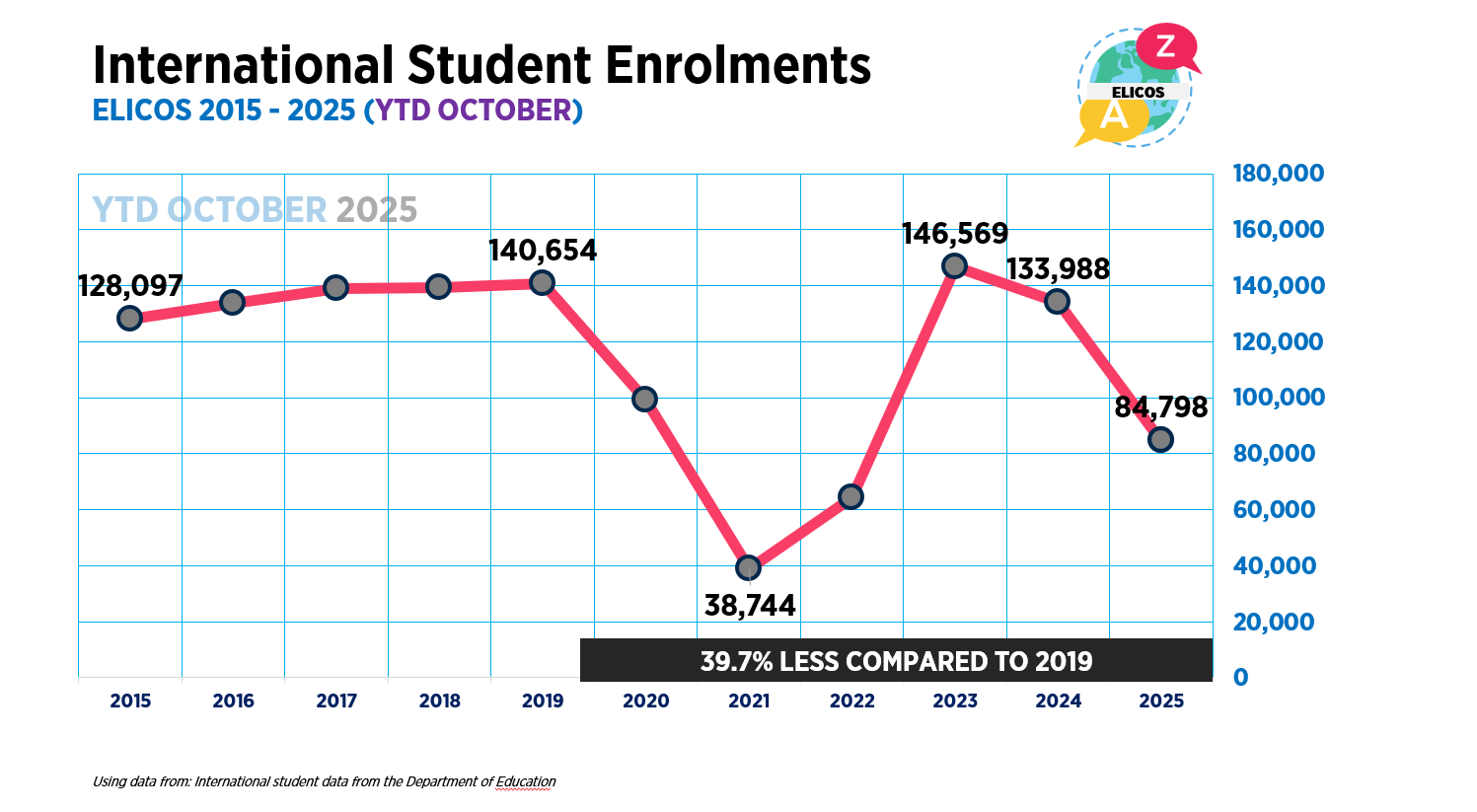
While it is true that not every English language student transfers to higher education, historically a meaningful proportion did. The decline in ELICOS enrolments has therefore directly impacted onshore progression pathways.
Impact
This shift raises important questions about impact. Some may argue that overall higher education international enrolments remain strong, and therefore there is little cause for concern. However, the consequences of this change extend beyond headline numbers.
- Student diversity: One clear implication is a change in student diversity. Historically, many international students required what we might describe as a ‘soft landing’ — the opportunity to come to Australia; improve their English, adapt to the academic and cultural environment; and then make decisions about their next step. International education is often a journey. Students may arrive with one plan and, after completing an English language program, seek new opportunities.
- Exposure to volatility in offshore markets: These shifts in pathways and partnerships mean that education providers will need to increasingly rely on offshore recruitment. The previous onshore pathway model provided a degree of cushioning against volatility in offshore markets. A substantial cohort of international students already in Australia represented potential future enrolments across other sectors. As that onshore group shrinks, institutions may become more dependent on offshore demand which is more volatile and competitive.
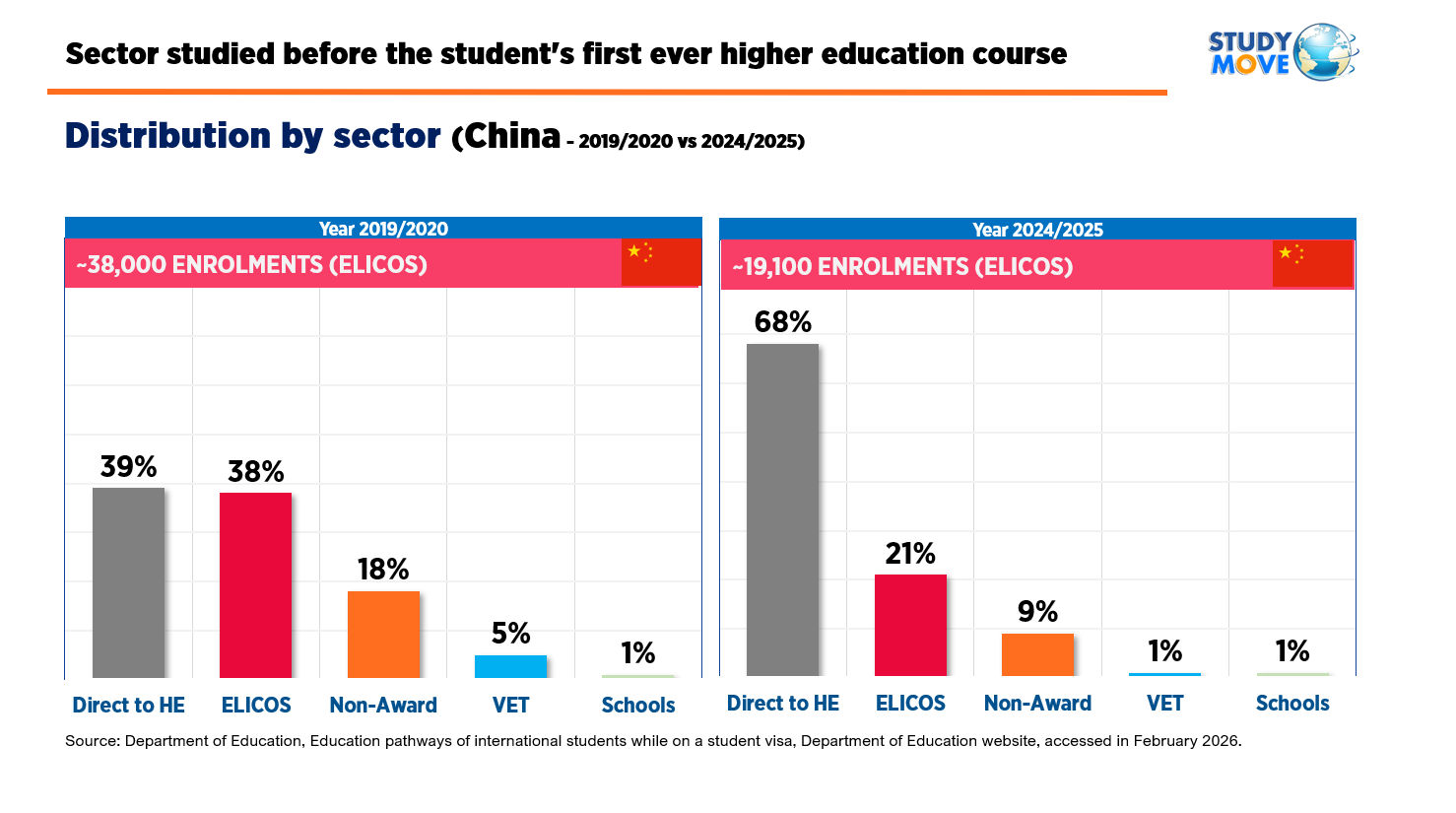
The example of China illustrates this point. In 2019, 39% of Chinese students entered higher education in Australia directly, while 38% progressed from ELICOS into higher education. Today, 68% enter higher education programs in Australia directly. As we have seen in recent months, student preferences in China are shifting and these shifts are already affecting higher education commencements. Had the onshore pathway pool remained as strong as it once was, the impact of such changes might have been less pronounced.
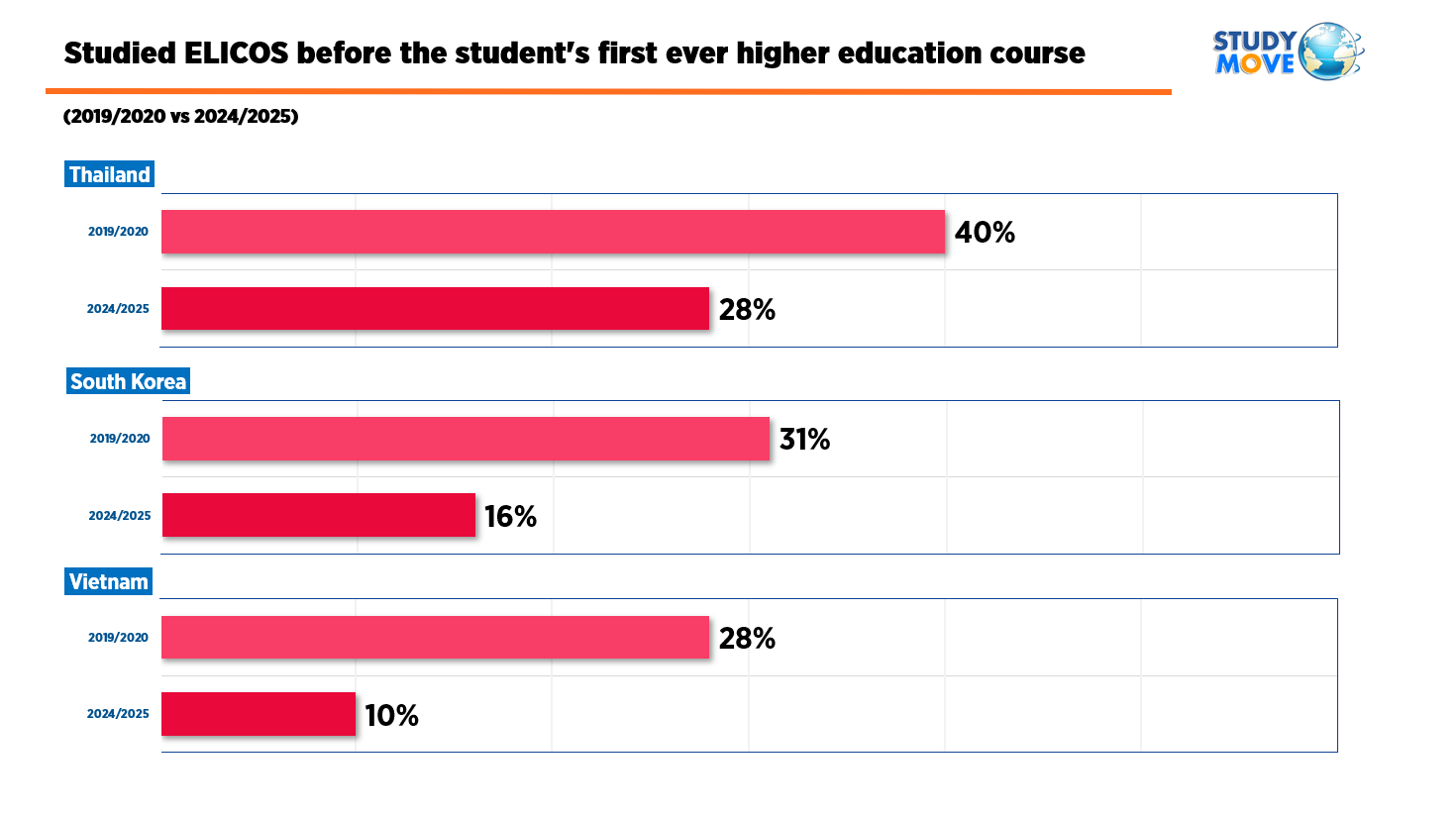
This also rings true for other key markets, including Thailand, South Korea and Vietnam.
- Higher costs: There is also a financial dimension to consider. Recruiting international students offshore is generally more expensive than recruiting international students who are already onshore. Many providers are reporting rising recruitment costs. The weakening of cross-sector partnerships, particularly between ELICOS and higher education, may therefore be contributing not only to increased volatility but also to higher acquisition costs.
- Our sector’s identity: Finally, one of the biggest issues for me is how this change in partnerships is reshaping the identity of international education in Australia. We seem to be moving from being a country that once welcomed international students who, once here, could explore all the opportunities on offer, to a model that increasingly restricts international students to pursue what they had chosen to study before arriving.
This is a significant shift and is clearly changing the nature of international education in Australia. Partnerships and pathways within international education have long been a strength of the sector. We will need to look for ways to revitalise and strengthen these partnerships into the future.