In 2020, I started researching resilience. I enrolled in the Executive Doctor of Business Administration transnational program offered by UTS, in partnership with SKEMA Business School and iaeLyon in France, and the Business Science Institute, Luxembourg.
During my studies, I interviewed 35 of Australia’s international education leaders and reviewed 170+ peer reviewed publications in management, psychology and education to explore the complex attribute of resilience.
My own career in international education began in the 1990s. I was the first international student officer appointed in UTS’ Faculty of Business. I spent eight years at UNSW International and five years as Executive Director at Macquarie International.
Following these university-based roles, I moved into government and led international vocational programs at Sydney TAFE and, subsequently, the international schools, vocational training and adult migrant English language programs for NSW’s Department of Education. I then spent two years as Executive General Manager at Navitas’ University Pathways Division.
I reflected on my experiences in these roles as I searched for insights into resilience. Some major challenges turned out well and left me feeling energised and invigorated; other times we succeeded but I felt completely defeated by the process. I didn’t understand why.
Then there were times when things didn’t work out. On some occasions, I embraced learnings and moved forward; other times a bruising outcome felt unresolved long after the event. This didn’t make much sense either.
I started to think the answer might be less about what we experience and more about how we experience. Maybe success and enjoyment of work challenges is less about content and context, and more about the dynamic construct of resilience, which changes constantly and not always in the direction you might expect.
It’s hard to think of a sector which requires more sustained demonstration of resilience than international education. We operate at the nexus of complex global economic, cultural, regulatory and geopolitical factors in every source and destination country accompanied by transformational change in education development and delivery, constant volatility and uncertainty. It seems we thrive on complexity and are hard-wired to embrace challenges including national policy change and market volatility. The question is, when did our hard-wired bunch last give much thought to the wiring? How many institutions or individuals actively focus on resilience as a leadership and performance attribute?
Ledesma states that ‘resilience is a crucial resource for leaders as it contributes to their survival, adaptation and success, especially in a complex working environment’. The World Economic Forum Future of Jobs Report 2025 has identified resilience as one of the top ten skills for the future.
As I started to dig into resilience in workplace settings, I also found there wasn’t much to dig through. Most existing research focuses on organisational-level resilience or people who experience work-place trauma such as first responders, military personnel and nurses. What about resilience for people in other organisational settings?
Literature which specifically focused on resilience in education settings addressed schools and classroom-facing roles. There was nothing for non-teaching staff in education settings and certainly nothing for my international education colleagues who, by 2020 when I enrolled, had already weathered their fair share of challenges and several ‘perfect storms’.
There is even less research on our leaders, and they are a little different. Their roles are more isolated, more intensive and demanding, and they have a broad span of control and influence. A leader’s resilience is critical not only for themselves but for the teams and functions they lead. If our leaders are low on resilience, the impact is magnified.
It turns out our leaders don’t really give much thought to resilience either. After interviewing more than 30 leaders in our sector, they cited resilience as ‘incredibly important’ and ‘essential to my success’. When I asked how much time they spent working on their resilience, they also stated, ‘it’s not something I think about’ and ‘I don’t really give it much thought’. This is problematic. If leaders don’t fully appreciate what it takes to develop and sustain resilience, they won’t be well equipped to identify low resilience for themselves or their teams or to achieve enhanced outcomes.
How can something be so important and at the same time, something we don’t understand or value? Possibly because resilience is a complex higher order construct which is unbelievably tricky to define and therefore difficult to understand.
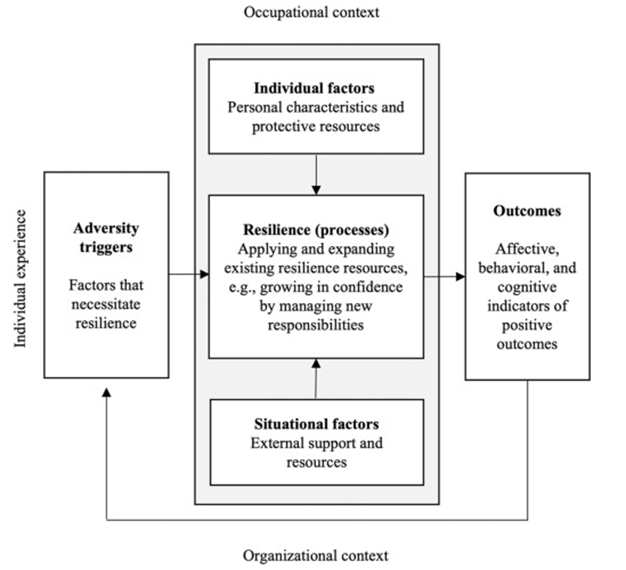
Source: Duchek et al., 2022
Researchers can’t agree on what resilience is. Hundreds of definitions exist. Fisher et al., 2019 note resilience has been referred to as an ‘ability’, a ‘developable capacity’, a ‘personality trait’, a ‘coping competency’ and a ‘process’. What I have learned is that resilience is formed from a complex melting pot of personality traits, experiences, environment, beliefs, processes, outcomes and practices. Resilience is impacted by enduring characteristics and transitory factors. It’s easy to understand why it’s almost impossible to measure and constantly changing. The good news is we can train ourselves to understand it and exercise behaviours more conducive to building and sustaining resilience.
Here are some of the research findings from my exploration of practices, perspectives and experiences of resilience:
Challenges are necessary and strengthening: Exposure to challenge and adversity, with the appropriate degree of respite and recovery, strengthens resilience levels and self-efficacy to address future challenges.
Sensemaking impacts resilience: How we process challenge and adversity impacts resilience. Resilient leaders engage in reflective practices and look for opportunities to learn from positive and negative experiences.
Our leaders need good leadership: Leaders don’t need to be told how to do the work, but they are more resilient in environments with great strategy, alignment of values, strong governance and opportunity to exercise autonomy and authority.
Engagement and community are important: Resilient leaders have access to trusted connections such as a positive supervisor relationship, mentorship and a sense of community, alignment or belonging.
Trust is crucial to fostering strong resilience: Without trust in your leadership or in your team, you second guess, ruminate, hesitate and endure heightened levels of emotional labour. Nothing depletes resilience more than insufficient trust.
Leaders thrive on workload: Perhaps counter-intuitively, workload for leaders creates a motivating sense of value and impact. Leaders view work as a source of achievement, comfort and familiarity, which contradicts the idea that work itself is harmful to resilience. Not all types of work prompt the same levels of resilience; rewarding and valued work energises leaders, whereas futile, devalued or stigmatised initiatives depletes leaders.
I now understand resilience to be the enduring quality which carries us through inevitable challenges, adversity and opportunities which exist in work and life. If you build your understanding of resilience, you will be well positioned to navigate whatever is ahead, for your career in international education and beyond as well as your life outside of work.