Since the emergence of international education as a commodified product throughout the 1980s and 1990s, enrolments have been dominated by institutions located in four countries – the United States, United Kingdom, Canada and Australia – often referred to collectively as the ‘Big Four’.
Sought out by students seeking an English-language-based education in countries with high standards of living, the Big Four have, over the last 40 years, educated millions of students pursuing educational, lifestyle and career opportunities not available in their home countries.
But the tight grip these four countries have held on the lion’s share of global enrolments is slipping.
While the total pool of international students growing, the proportional share studying at Big Four destinations appears to be declining. According to UNESCO, in 2013 the Big Four accounted for around 33% – or one in three – inbound international students of all study levels worldwide. This number has steadily and progressively declined. In 2021 (the most recent year for which robust data is available), the figure had dropped to just under 25%, or one in four. A realignment appears to be emerging.
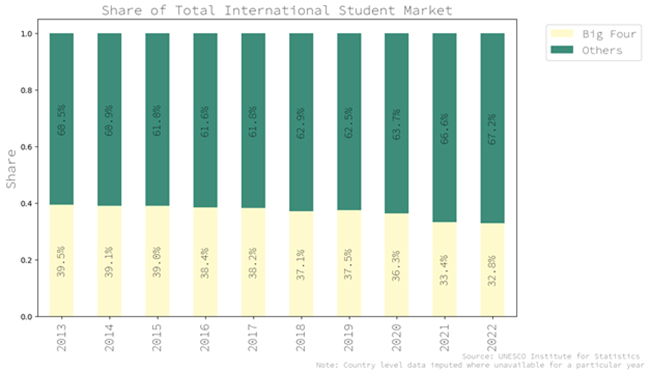
Might this trend continue into the future? Analytics data from the QS Topuniversities website, through which prospective students can research universities from around the world, may serve as a ‘leading indicator’ for enrolment trends in the near future – at least for university-level study.
The data shows the continuation of the Big Four’s decline. In the first six months of 2024, 48.5% of page views were for institutions within the Big Four. In the equivalent period of 2025, that figure had fallen to 45.7%.
Most of this decline is attributable to US institutions, for which the share of overall views fell from 19% in 2024 to 16.4% in 2025 – a 2.6% point drop. This may reflect domestic turbulence and the emergence of immigration as a hot-button political issue.
In contrast, Australia’s share fell by 0.2% points, Canada’s by 0.6% points and the UK’s share rose by 0.7% points.
| |
H1 2024 |
H1 2025 |
| Big Four |
48.5% |
45.7% |
| Other Locations |
51.5% |
54.3% |
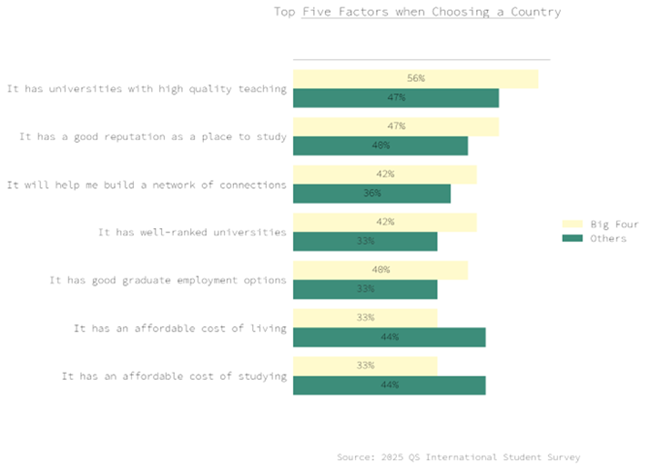
But what might determine whether a student sticks with the Big Four or looks at other destinations? Along with fraught immigration conditions – arguably present in all four countries,though not to the same extent as in the US – cost-of-living and tuition fee concerns appear to be key decision-making factors.
According to the 2025 QS International Student Survey, 44% of prospective students (all study levels) who said they were likely to choose a destination outside the Big Four highlighted cost of living as a top concern, compared to only 33% of those who said they were likely to study within the Big Four. A similar trend has also emerged for tuition fees.
Conversely, students more likely to choose a Big Four destination were more inclined to value high-quality teaching, the reputation of the destination country, networking opportunities and access to highly ranked institutions – in other words, prestige and quality over cost considerations.
If not the Big Four, then where?
Looking back at UNESCO data, Turkey has seen the most growth in global enrolment share between 2013 and 2023, now accounting for 3.4% of all enrolments – an increase of over 2%. The United Arab Emirates also saw a 2% increase, Argentina grew by 1.8%, and Germany by 1.1%.
Some of this growth may be attributable to the rise in English-medium instruction (EMI) courses. A 2025 study estimated over 24,000 EMI courses were taught in Europe during the 2023/24 academic year– a threefold increase from 2013.
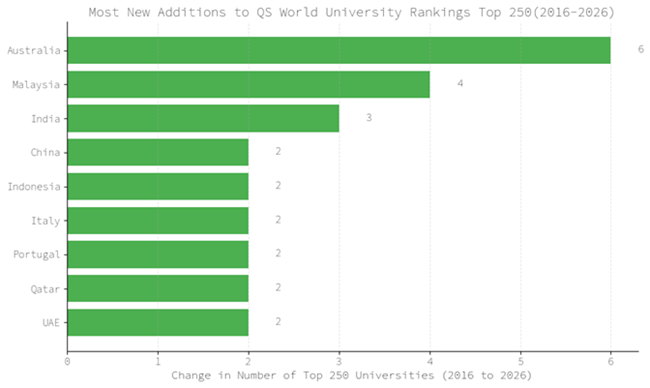
The growth in quality and prestige of higher education institutions outside the Big Four may also be contributing to this new dynamic of increased competition. In the last 10 years, Malaysia has seen the number of top-250 ranked universities in the QS World University Rankings grow from one to five, India from three to six, China from eight to 10, and Indonesia from zero to two.
These emerging markets – which often offer lower tuition fees and living costs – may provide an increasingly compelling value proposition for cost-sensitive students.
So what should be done about all of this?
The 2025 QS Global Student Flows Report forecasts 8.5 million international students by 2030. With an increasingly large pie, perhaps a proportionally smaller slice will still satisfy the enrolment appetite of the Big Four (or even exceed it, given the introduction of international enrolment caps in Australia and Canada). In doing so, this could give middle-income countries which invest in their higher education sector the opportunity to retain more of their most promising students, and diversify their own campuses in the same way that institutions in the UK, USA, Canada and Australia have done in decades past to attract international students.
Complacency, however, may also not deliver. If there truly is a shift taking place in what prospective international students value when selecting a study destination, and if the Big Four stand to become a less globally competitive proposition as a result, then it is these four countries which must adapt, to modernise and to ensure that offerings align with what the growing global middle class values.
Time will tell whether this trend continues, or whether future global conditions – such as an improving economic outlook or more liberal approaches to migration policy – lead to a rebound for the Big Four and their institutions.
Should this drift away from the Big Four persist, internationalisation may be tested against the hard calculus of institutional balance sheets and performance targets.