With so many available metrics, it can be challenging to understand the effects of the new policy framework.
We often hear about net migration, student arrivals, and enrolment numbers, but how can data truly help us measure the impact of recent policies designed to curb the number of international students in Australia?
In recent weeks, the Studymove team has taken a closer look at this. We recommend that the number of temporary student visa holders is the most reliable indicator of the impact of government policies.
This metric, reported by the Department of Home Affairs, captures the actual number of international students currently in Australia, reflecting both new student arrivals and those continuing their studies. By analysing trends in student visa holders, we can gain a clearer picture of the impact of policies—such as Ministerial Directions 107 and 111.
Australian international education has undergone a dramatic shift due to policy changes introduced by the Australian Government throughout 2024. One of the main goals of these policies has been to stop the growth in the number of student visa holders in Australia.
The historical trend in the number of temporary student visa holders shows that Government policies have achieved this goal.
Changes in the number of temporary student visa holders
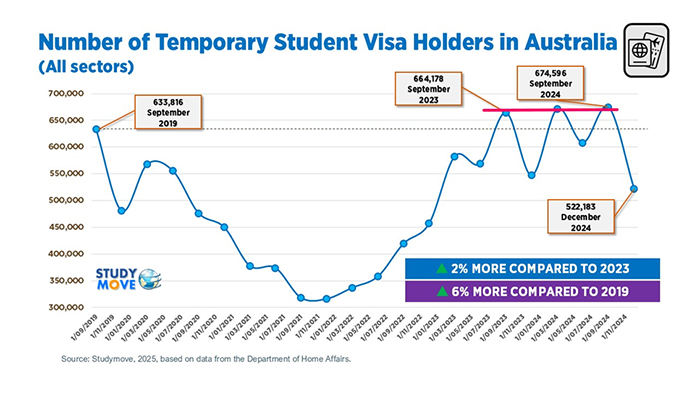
As of September 2024, Australia had approximately 664,000 temporary student visa holders, reflecting a 2% increase from September 2023. This figure stands in stark contrast to the rapid recovery seen throughout 2023, when the number of student visa holders rebounded significantly from COVID-related declines.
In comparison, in September 2019, before the pandemic and recent policy shifts, Australia hosted around 630,000 temporary student visa holders. This means that after five years, the increase in student visa holders is only 6%.
Flattening the growth of student visa holders in just 12 months is a significant outcome highlighting the impact in the international education sector.
End of year (December) data is another reference point that confirms the effects of the new policy framework. Department of Home Affairs data shows a 5% decrease in the number of temporary student visa holders reported in December 2024 (compared to December 2023). This is the first time since 2022 that there has been a decline in temporary student visa holders compared to the same period in the previous year.
Meanwhile, other visa categories are still growing
The 2% growth in temporary student visa holders from September 2023 to September 2024 is even more striking when compared to other visa categories.
While the Government implemented measures to curb student visa numbers, other temporary visa categories increased.
For example, working holiday visas experienced a 33% increase between September 2023 and September 2024, while temporary skilled worker visas rose 31%. Bridging visas, which allow individuals to remain in Australia while awaiting immigration decisions, surged by an astonishing 77%.
| VISA CATEGORY |
NUMBER OF VISAS |
GROWTH COMPARED TO
SEP 2023 |
| ALL TEMPORARY VISA HOLDERS |
2,796,146 |
+6% |
| Special Category |
720,330 |
0% |
| Student |
674,596 |
+2% |
| Bridging |
338,271 |
+77% |
| Working Holiday Maker |
192,565 |
+33% |
| Temporary Resident (Skilled Employment) |
183,713 |
+31% |
| Temporary Graduate |
228,278 |
+18% |
| Visitor |
332,563 |
-2% |
| Temporary Resident (Other Employment) |
100,848 |
-53% |
This dataset raises an obvious question as to why policymakers have focused policies to constrain the number of student visa holders while other categories have continued to grow.
The Importance of data in navigating uncertainty
Assessing the number of student visa holders is crucial for understanding the overall impact of policy changes on our sector. Unlike other data, this metric provides a direct count of individuals studying in Australia, offering a clearer picture of the actual presence of international students. In contrast, other metrics, such as commencement and enrolment data, can be misleading since a single student can enrol in multiple courses within a year.
This difference is evident in the data. For example, as of September 2024, the number of temporary student visa holders was 674,596, representing only a 2% increase compared to 2023. However, data from the Department of Education shows more than 1,000,000 international enrolments in the same period, reflecting a 14% increase compared to the same period in 2023. This overstates the actual growth of international students, as it counts course enrolments rather than unique individuals.
With 2025 expected to be another volatile year, closely monitoring the number of student visa holders will be essential for the sector to navigate ongoing uncertainty and adapt to potential challenges in the months ahead.